
How to Pass Micro1 AI Interview (My Experience)
If you’ve been in the remote job market recently, you’ve probably noticed that interviews don’t feel the same anymore. Instead of sitting across from a hiring manager trying to read their facial expressions and adjust your tone in real time. Now, more often than not, you’re having an interview with AI that can misinterpret your responses very easily.
The hiring landscape has shifted faster than most people expected. Companies are scaling globally, roles are getting more specialized, and recruiters are overwhelmed. To keep up, businesses have started relying on automation and that’s where AI interviews come in. Platforms like Micro1 are not just experimenting with AI, they’re fully integrating it into their hiring pipelines.
Since this has become our reality now, the smarter move is learning how to play the game, and play it well instead of resisting it. And that’s exactly what I did after my failed attempts. I’ll share with you how I cracked the code of Micro1 AI interview and how I passed it so you can be able to make money through AI training jobs.
What’s Micro1 AI Interview?
When you sign up to Micro1 and add your resume and information, you’ll be invited to take an AI interview with Micro1 AI recruiter. This interview is like a certification to verify your area of expertise. Once you pass it, you’ll be added to their pool of AI training jobs related to your domain. The interview is a live video meaning you’ll have to use your webcam and microphone. You’ll sit there facing a digital avatar, that’s Micro1 AI recruiter called Zara.
Note that you don’t grant a lifetime access to all their projects. This interview is only for joining their pool. You may have to take other assessments and interviews individually for every project you apply to. So learning the right techniques on how to pass the initial interview will help with the other ones since the process is almost the same.
My First Reaction to the Micro1 AI Interview
For me, the first few minutes felt awkward. I caught myself overthinking everything, my tone, my pauses, even where I was looking. Without a human reacting in real time, it almost felt like speaking into a void.
We’re wired to communicate with people. We rely on nods, smiles, interruptions to guide our responses. But with Zara, that feedback loop is different. You have to trust your own delivery without external validation.
The trick is to normalize the experience quickly. Treat Zara like a real interviewer and speak naturally. Once I got past that initial discomfort, I started focusing more on my sentence structure and less on impressions. And ironically, that made my answers stronger.
What I liked about this AI interview is, unlike traditional interviews, Zara isn’t looking to trap you. She’s not waiting for you to slip up. Instead, she’s evaluating patterns, how clearly you speak, how logically you organize ideas, and how effectively you communicate. Once I realized I am talking to a machine not a human who’s judging me, I was relieved a bit.
Understanding How Zara Actually Evaluates You
One of the biggest misconceptions I had going into the Micro1 AI interview was believing I needed the perfect answer for every question. That assumption turned out to be completely wrong and honestly, letting go of it made a huge difference in my performance.
Zara isn’t sitting there with a checklist of exact answers waiting to mark you right or wrong. Instead, the system is designed to evaluate how you think, not just what you say. It’s analyzing your reasoning process, your ability to break down problems, and how logically your ideas flow from one point to the next.
For example, if two candidates give slightly different answers but both demonstrate clear, structured thinking, they’ll likely score similarly well. On the flip side, someone who throws out a technically correct answer without explaining their reasoning might actually score lower.
During my interview, I noticed that whenever I slowed down and explained my thought process step by step, my responses felt stronger. Even if I wasn’t 100% sure about the solution, articulating how I would approach the problem gave Zara enough signal to evaluate my thinking.
So instead of chasing perfection, focus on clarity. Walk through your logic out loud. Use simple transitions like “first,” “next,” and “finally.” These small cues act like signposts for the AI, helping it follow your reasoning easily.
6 Steps to Pass the Micro1 AI Interview
Preparation goes beyond just practicing answers. Your environment and setup play a huge role in how well the interview goes just like any interview you do online. Along with other things including your facial expressions, gestures and posture, and more.
Prepare Your Setup and Background
Make sure you’re in a quiet space with minimal background noise. Good lighting is essential as the AI needs to clearly see your face. A poor video feed can actually affect your evaluation.
Test your microphone beforehand. Clear audio is just as important as clear speech. If possible, use headphones or an external mic to reduce noise. Also, do a quick system check. Close all tabs, ensure a stable internet connection, and eliminate potential distractions.
Keep Your Answers Under 2 MinutesAI interview systems like Micro1 don’t just analyze what you say; they also track how long you say it. From what I experienced and later confirmed through research, answers that go beyond two to two and a half minutes tend to lose effectiveness.
This happens because longer answers often introduce filler words that don’t add real value. Humans might tolerate that in a conversation, but an AI system sees it differently. It can interpret excessive length as a lack of clarity or poor communication.
I tested this myself during practice. When I spoke for too long, I noticed my answers started drifting. I repeated ideas, added unnecessary details, and lost structure. But when I forced myself to stay within a tighter time frame, everything improved. My points became sharper, and my delivery felt more confident.
A helpful mental model is to say what needs to be said, and then stop. No over-explaining and no trailing thoughts.
Use Simple Language
The thing I realized is using more complex language does not make you sound smarter to an AI. In fact, it often does the opposite.
Zara is trained to reward clear, concise communication, not jargon-heavy explanations. If you start listing tools, frameworks, or buzzwords without context, the system can interpret that as poor communication. It’s not impressed by how many technologies you name, it cares about how well you explain what you actually did with them.
I made this mistake in a practice session. I tried to sound impressive by mentioning multiple frameworks and tools in one answer. But when I reviewed my response, it felt cluttered and hard to follow. There was no clear story just a pile of keywords.
A good rule of thumb is if a non-technical person can understand your explanation, you’re probably on the right track.
Use Real Situations And Achievements
When Answering Questions One thing that significantly boosted the quality of my answers was adding specific examples and measurable results.
It’s easy to make general statements like “I improved performance” or “I worked on a successful project.” But those phrases don’t carry much weight especially for an AI system that thrives on concrete data. When I started including numbers, everything changed.
For example, instead of saying “I improved sales,” I said, “I increased sales by 25% over three months.” That single change make your answer more credible, more specific, and easier to evaluate.
Zara seems to pick up on these details. Numbers act like anchors, they give your story something solid to hold onto. They also demonstrate that you understand the impact of your work, not just the process.
Another important aspect is relevance. Your examples should align with the role you’re applying for. Real examples also make your answers feel more natural. Instead of sounding rehearsed, you’re drawing from actual experience.
Keep Your Eyes on The Camera
What caught me completely off guard is Zara doesn’t just listen to your voice, she watches you too. The system analyzes your video feed, including where you’re looking.
At first, I made the classic mistake of looking at my screen instead of the camera. It felt more natural, but it also meant I wasn’t making eye contact from the AI’s perspective. If you don’t maintain eye contact, the AI will think you are cheating or not focused.
Adjust Your Posture, Facial Expressions, and Gestures
Body language goes beyond just eye contact. Your posture, facial expressions, and even hand movements all contribute to how you’re evaluated.
Sitting up straight might sound like basic advice, but it actually impacts how you’re perceived. Good posture conveys confidence and professionalism.
Facial expressions are a bit more nuanced. You don’t need to force a constant smile (and you shouldn’t). In fact, overly exaggerated expressions can come across as unnatural. The goal is to stay relaxed and neutral, with occasional natural smiles.
Hand gestures are another interesting factor. A bit of movement is fine as it can even enhance your communication. But excessive or erratic gestures might be interpreted as nervousness. I found that keeping my hands loosely visible and controlled worked best.
All of this might sound like overkill, but it’s really just about presenting yourself clearly and confidently. The same principles that apply in a human interview still apply here but the difference is that they’re being analyzed more precisely.
The 5 Key Question Categories You Must Prepare For
Background and Tell Me About Yourself Question
This question seems too easy. But surprisingly, it’s where a lot of people lose points because they treat it like casual storytelling.
In a human interview, a bit of personality and storytelling can work in your favor. But with Zara, long, unstructured answers can hurt you. The AI isn’t trying to get to know you in a personal sense, it’s trying to extract clear, structured information about your professional identity.
When I first practiced this question, I caught myself rambling. I started from my college days, drifted into unrelated experiences, and by the end, I wasn’t even sure what point I was trying to make. That’s exactly what you want to avoid.
Zara performs best when your answer has a logical flow. Think of it like giving a short, well-organized introduction rather than telling your life story. You want to make it easy for the system to identify key data points like who you are, what you’re good at, and why you’re here.
Technical Skills Questions
Once you move past the introduction, the interview usually shifts into technical territory. These questions are tailored to your role, so the exact content will vary. But the evaluation pattern remains consistent.
Zara isn’t just checking whether you know something, it’s checking whether you can explain it clearly.
If you are applying for a technical job, instead of diving into deep technical jargon, focus on outlining your approach step by step. The key is to balance depth with clarity. You want to show competence without overwhelming the system with unnecessary complexity.
Also, one of the easiest mistakes to make here is when you list a bunch of tools or technologies without explaining how they’re used.
For example, saying “I’ve worked with OpenShot, ShotCut, Kdenlive and Lightworks” doesn’t tell Zara much. It’s just a list with no context or situations to highlight your expertise.
Instead, tie each tool to a specific outcome. Explain what problem you solved and how the tool helped. Or what a client requested from you and how you used the tool to deliver that. This transforms your answer from a static list into a dynamic explanation.
Scenario-Based Problem Solving
Scenario questions are where things get interesting and a bit more challenging. These are designed to simulate real-world problems and see how you respond under pressure.
You might be asked something like, “How would you fix a specific problem?” or “How would you design this product?” It depends on your domain.
The best way to approach these questions is to think out loud in a structured way. Start by defining the problem. What exactly is happening? What information do you have? This shows that you understand the situation before jumping into solutions.
Next, outline your approach step by step. Use clear transitions like “first,” “then,” and “finally.” This makes your answer easier to follow and signals logical progression.
Finally, talk about how you would measure success. This is a step many candidates skip, but it’s incredibly important. It shows that you’re not just solving problems, you’re validating solutions.
When you break your answer into these stages, you’re essentially guiding the AI through your thought process. And that’s exactly what it’s designed to evaluate.
Communication and Teamwork Questions
Zara wants to know if you can communicate complex ideas clearly, especially to non-technical stakeholders (which is going to be the AI model that you will train.)
You need to translate technical concepts into everyday language. Think analogies, real-world examples, and business outcomes. Elaborate as if you are explaining it to someone who knows absolutely nothing about your work.
Ethics, Safety, and Motivation Questions
You might be asked about the risks of using AI in sensitive areas like healthcare or finance. These questions aren’t about technical depth, they’re about awareness and responsibility.
A strong answer here acknowledges real risks and proposes thoughtful solutions. For example, you might mention data privacy concerns, bias in AI models, or the risk of incorrect predictions. But don’t stop there, explain how you would mitigate those risks. This shows that you’re not just technically capable, but also ethically aware.
In my experience, these questions felt more like conversations than tests. They gave me a chance to demonstrate a broader understanding of technology’s impact.
What to Do If You Don’t Understand a Question
At some point during the interview, there’s a good chance you’ll hear a question that doesn’t fully make sense. Maybe it’s phrased in a way you didn’t expect, or maybe it touches on a concept you’re not entirely familiar with.
What I learned is that Zara is designed to be interactive. You can actually ask for clarification without being penalized. Something as simple as, “Could you please rephrase the question?” works perfectly fine.
If you still don’t fully understand after clarification, focus on what you do know. Break the question down, address the parts you recognize, and explain your reasoning. Even an incomplete answer can score well if it’s structured and logical.
The key is to stay composed. Silence is okay. Taking a moment to think is okay. What matters is how you recover and respond.
How I Practiced for the Micro1 AI Interview Using ChatGPT
Preparing for this interview wasn’t something I could just wing. The format is too different, and if you go in unprepared, it shows immediately. So I treated practice as seriously as the actual interview. Instead of just reading questions, I actively simulated the experience, speaking out loud, timing myself, and refining how I structured my answers. That shift from passive prep to active practice made a noticeable difference.
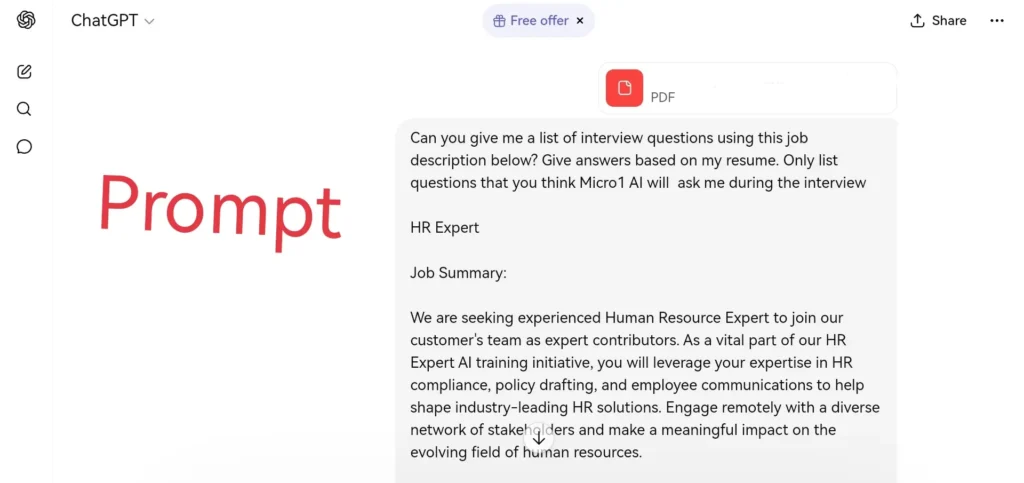
The first tool I used was ChatGPT, and honestly, it became my starting point for everything. I uploaded my resume and Micro1 AI job description, and asked ChatGPT to generate interview questions and answers tailored to my background. This part helped me to see how clear, simple and straightforward the answers are which I tired to mimic since this is what AI likes.
Don’t memorize, copy or read these answers during your interview. Only use this method to practice and train yourself how to answer questions.
How Final Round AI Helped Me With Mock Interviews
If I had to point to one thing that truly prepared me for the Micro1 interview, it would be mock interviews, specifically using platforms designed to simulate AI interviews which is what exactly Round AI offers.
Practicing on ChatGPT helped me shape my answers, but Final Round AI helped me experience the real pressure and format of an AI interview. It felt much closer to the actual Micro1 setup (camera on, timed responses, and a system evaluating how you speak, not just what you say.)
What stood out immediately was how different it felt compared to practicing alone. When you’re on a timer and being recorded, your behavior changes. You become more aware of your pacing, your pauses, and even your body language. That exposure is crucial because the real interview won’t wait for you to figure it out.
One of the most valuable features was the feedback analysis. After each mock session, the platform highlighted areas where I needed improvement, things like clarity, filler words, response length, and structure. It wasn’t vague advice either; it pointed out specific patterns, like when I over-explained or when my answers lacked a clear conclusion.
Another feature I found incredibly useful was the AI-driven scoring and breakdown. It gave me insight into how an actual system might evaluate me. Instead of guessing whether an answer was good, I had measurable feedback. That allowed me to iterate quickly, fix mistakes, test again, and improve in a structured way.
It also helped with body language awareness, which is something most people underestimate. Seeing myself on camera made me realize small things like not maintaining eye contact with the lens or using too many hand gestures. These are details you don’t catch unless you practice in a realistic environment.
Looking back, mock interviews weren’t just helpful, they were essential. They bridged the gap between knowing what to say and actually delivering it under real conditions. By the time I sat for the actual Micro1 interview, nothing felt unfamiliar. And that level of comfort is exactly what you need to perform well.
Conclusion
Preparing for a Micro1 AI interview might feel intimidating at first, but once you understand how the system works, it becomes much more manageable. It’s not about memorizing perfect answers or trying to outsmart the AI. It’s about communicating clearly, thinking logically, and presenting your ideas in a structured way.
At the end of the day, it’s still an interview. Confidence, clarity, and preparation will always win whether you’re speaking to a human or an AI.
