
I stumbled upon Mercor AI one time while searching for a remote job. Their high pay rates specifically are what caught my attention so I decided to give it a shot.
I had spent hours polishing my resume until I realized I won’t take a written assessment rather I had to complete a 14 minutes Domain Expert AI interview which confused me the most. What exactly is an AI interview? Is someone watching me live? How do I even prepare for something like this?
It’s funny because we’re so used to traditional interviews. You walk in, shake hands, try to read the room, maybe crack a small joke if the vibe feels right. There’s a rhythm to it. But this felt like stepping into something completely unfamiliar. It wasn’t just about answering questions anymore, it was about understanding a system.
And if I’m being honest, the uncertainty was the hardest part. That’s what makes these interviews intimidating at first. But once I went through it, made mistakes, and figured out what actually matters, I realized that this isn’t harder than a normal interview. It’s just different.
What a Mercor AI Interview Actually Is
A Mercor AI interview is asynchronous, which basically means it’s not happening in real time. You’re not talking to a live person. Instead, you’re recording your answers, and the system processes them later. The entire thing usually takes around 14 minutes.
You have to consider that there’s no back-and-forth conversation as you won’t have to improvise based on someone’s reactions. It’s just you, the camera, and a set of questions that may adapt based on your responses.
That doesn’t mean humans aren’t involved at all. They are. But they come later. First, the AI processes your responses. It listens to what you say, converts your speech into text, and evaluates it based on certain criteria.
That detail changed everything for me. Because once you realize your spoken words are being turned into text, you start thinking differently about how you speak. Clarity becomes more important than charisma and structure becomes more important than storytelling flair.
My First Attempt (And What I Got Wrong)
I didn’t pass on my first try. And honestly, I’m glad I didn’t because I made almost every mistake you can imagine.
My biggest mistake was treating it like a traditional interview. I rambled, overexplained and used filler words. I told long stories before getting to the point. Basically, I did everything you’d normally do when you’re trying to connect with a human recruiter. I thought that would help me stand out. Instead, it worked against me.
In a normal setting, storytelling can be powerful. You build context, create a narrative, and guide the listener toward your point. But in an AI interview, that approach can backfire because the system is only looking for clear and structured information.
When I went off on tangents, the main point of my answers got buried. If someone had been sitting across from me, they might have followed along. But the AI? It just saw a block of text without a clear structure.
The Silence That Threw Me Off
Another thing that caught me off guard was the silence. After each question, there’s this brief moment where you’re expected to respond. And if you hesitate too long without saying anything, it can feel like the system is just waiting.
At one point, I paused to think, said nothing, and the recording moved on sooner than I expected. That moment alone taught me that I have to signal that I am still thinking. So in my next interviews, I started using simple phrases like “That’s a great question or “let me think for a second.” This keeps the system engaged and buys you time.
Understanding How the AI Really Works
After my first failed attempt, I stopped focusing on what I was saying and started questioning something more fundamental: how is this system even judging me? Because once you strip away the human interviewer, the entire process feels almost abstract. You’re no longer trying to impress a person, you’re trying to satisfy a system that translates speech into structured data. And that shift changes everything.
What I eventually learned is that the Mercor AI interview isn’t listening in the emotional sense we’re used to. It’s not reacting to your confidence, your smile, or your storytelling flair. It’s breaking your response into components: words, structure, clarity, and signals like specificity and relevance. That means your success depends less on personality and more on how cleanly your information can be interpreted. So instead of trying to perform, you can focus on being precise.
Also, the AI isn’t just hearing your voice, it’s converting everything into text and then analyzing that text like a dataset. So when you speak, you’re essentially writing in real time.
That realization completely changed how I approached answers. I started imagining that every sentence I spoke would immediately appear on a screen in front of a recruiter. Would it make sense if read without tone? Would it still be clear without my voice inflection? Would the main point still stand on its own?
And that’s where most people go wrong. They rely too much on how something sounds rather than how it reads. But in this format, readability is everything.
Another thing I noticed is that the system pays attention to structure cues. When you clearly separate your answer into parts like situation, action, and result, it becomes much easier for the AI to interpret your intent. It’s almost like labeling your thoughts in real time.
Once I started thinking this way, my answers became shorter, clearer, and more intentional. I stopped trying to impress and started trying to communicate in a way that a machine could reliably interpret.
The Setup Matters More Than You Think
I used to think preparation meant only rehearsing answers. That was a mistake. With AI interviews, your environment matters just as much as your responses.
On my first attempt, I underestimated this completely. I thought as long as I had a working laptop and decent internet, I was good to go. But I was wrong.
Small issues like bad lighting, background noise or microphone sensitivity, don’t just affect your experience. They affect how accurately your speech gets transcribed. And if your words aren’t transcribed correctly, your answers lose clarity before they’re even evaluated.
Before starting the interview, make sure to sit in a quiet room and test your camera and microphone properly. Try speaking at different speeds to see how accurately the microphone picks up your voice. Position yourself facing a light source so your face is clearly visible.
Also, switch to a more stable browser (Chrome worked best for me) and close all tabs. The AI can detect running tabs in the background and will think you are cheating.
The Types of Questions You’ll Get
The interesting thing about Mercor AI interviews is that the questions aren’t random in the way people assume. They feel unpredictable in the moment, but they actually fall into a few clear patterns. Once I recognized those patterns, the anxiety dropped significantly.
Background and Experience Questions
These are the opening questions in most cases. They’re designed to confirm what’s already on your resume. Think of them as the system checking if your spoken explanation matches your written application.
A typical question might sound like: “Tell me about a recent project you worked on.”
The mistake I made early on was treating this like storytelling time. I’d start with context, add background, mention the team, describe the situation and only later get to what I actually did. That doesn’t work here.
What works better is immediate clarity. You start with your role and your action. The system is essentially trying to answer one question: what did you personally contribute?
So instead of saying “we worked on improving a system,” it needs to hear “I built X, I optimized Y, I managed Z.” That distinction sounds small, but it completely changes how your response is interpreted.
The more direct you are, the easier it is for the AI to extract meaningful data from your answer.
Skills and Results-Based Questions
This is where things get more technical. These questions dig into whether you actually used the tools and skills you listed on your resume.
A common example would be: “How did you use this skill to achieve results?”
Instead of saying you “improved efficiency,” you say: “I used Excel automation to reduce reporting time by 2 hours per week.” The AI responds well to measurable outcomes because numbers are unambiguous. There’s no interpretation needed. Either something improved by 2 hours or it didn’t. That clarity makes your answer stronger in the system’s evaluation process.
Problem-Solving Scenarios
These scenarios usually sound like: “How would you handle a project that is going off track?” or “What would you do if a key system failed?”
At first, I tried to come up with perfect answers. But the reality is much simpler.
Always adopt a step-by-step thinking style when answering these questions. Almost like narrating a process in real time:
First, I would identify the issue. Second, I would gather relevant information. Third, I would implement a fix. And fourth, I would evaluate the outcome.
That kind of structured thinking is easy for the system to interpret and score.
Communication Follow-Ups
You give an answer, and then the AI follows up with something like: “Can you explain that more clearly?”
The first time this happened to me, I thought I had done something wrong. But that’s not what it means.
It’s actually testing clarity. If your answer is too complex, too fast, or too vague, the system tries to simplify it by asking for clarification. So it’s basically a second chance to explain yourself more.
Simplicity wins every time. Explain every thing using simple and clear vocabulary. Paraphrase in a better way.
Motivation and Decision-MakingYou may be asked questions like: “Why did you choose this approach?” or “What was your reasoning behind this decision?”
The system wants to see if your decisions make sense within a professional context. For example, did you choose a faster solution over a cheaper one because time was critical? Or did you choose a simpler tool because it reduced long-term maintenance? So what matters here is reasoning, not storytelling.
The Answering Strategy That Changed Everything
Most people don’t have a problem with answering questions. Their real problem is how to structure them in a way that the AI can easily interpret.
STAR Method
Imagine instead of jumping around in your explanation, you move through a clear sequence. You set context, define your responsibility, explain your actions, and end with measurable outcomes. This is what’s called STAR method (Situation, Task, Action, Result)
This helps drastically with how AI interprets your responses, and removes ambiguity that causes weak evaluations.
Before answering any question ask yourself about the situation, your responsibility, what you actually do and the outcome. Then speak naturally in that order.
The Biggest Mistakes You Must Avoid
After my second attempt, I spent a lot of time thinking about what actually went wrong the first time. It wasn’t lack of experience or poor qualifications. It was execution. Small habits, things that feel harmless in a normal conversation, become real disadvantages in an AI-scored interview.
Rambling and Overexplaining
In a human interview, we often believe more detail equals more credibility. So we add background, context, side explanations, and extra clarification, just to make sure we’re understood.
But in an AI interview, that approach backfires. When you ramble, your response becomes harder to structure. The transcript turns into a long block of text without clear separation between idea, action, and result. And that matters because the system is trying to categorize your response into meaningful components.
Instead of starting with context, try starting with the conclusion. Then support it briefly. That alone will make your answers feel more controlled and easier to interpret.
I overcome this problem after asking ChatGPT to read the job description and give me a list of interview questions and answers using my resume. I studied the answers carefully, how clear and precise it is, and tried copying its style when answering interview questions. Surprisingly, it worked.
Trying to Sound Too Smart
When you use overly complicated words or rare terminology, there’s a higher chance of misinterpretation. A slightly misheard word can change the meaning of your sentence in the transcript. And once that happens, your answer becomes less accurate in the system’s evaluation.
What I noticed is that simple language consistently performed better. Saying “I used automation to reduce manual work” is stronger than saying “I leveraged automated processes to optimize operational efficiency” in this context. The first one is clean, direct, and impossible to misread.
Reading From a Script
This is the most common mistake that we are guilty for it. After my first attempt, I seriously considered writing full answers in advance and reading them during the interview.
Even if the AI can technically process it, human reviewers eventually watch the video. And they can tell immediately when someone is reading.
Second, it breaks flow. When you read, you lose flexibility. You can’t adjust your answer based on how the question evolves. And since the system can ask follow-ups, that rigidity becomes a problem.
I recommend writing down keywords only just to jog your memory. This helps a lot.
The Two Tools That Actually Helped Me Prepare for Mercor AI Interviews
Having mockup interviews to practice can help you and increase your chances drastically of passing Mercor AI interview. So I started experimenting with different AI interview preparation platforms. Two of them genuinely stood out because they forced me to practice the format itself. And that’s where the real improvement came from.
Final Round AI: The Closest Thing to the Real Interview Experience
If I had to describe Final Round AI in one line, I’d say it feels like a complete AI interview simulator rather than just a practice tool.
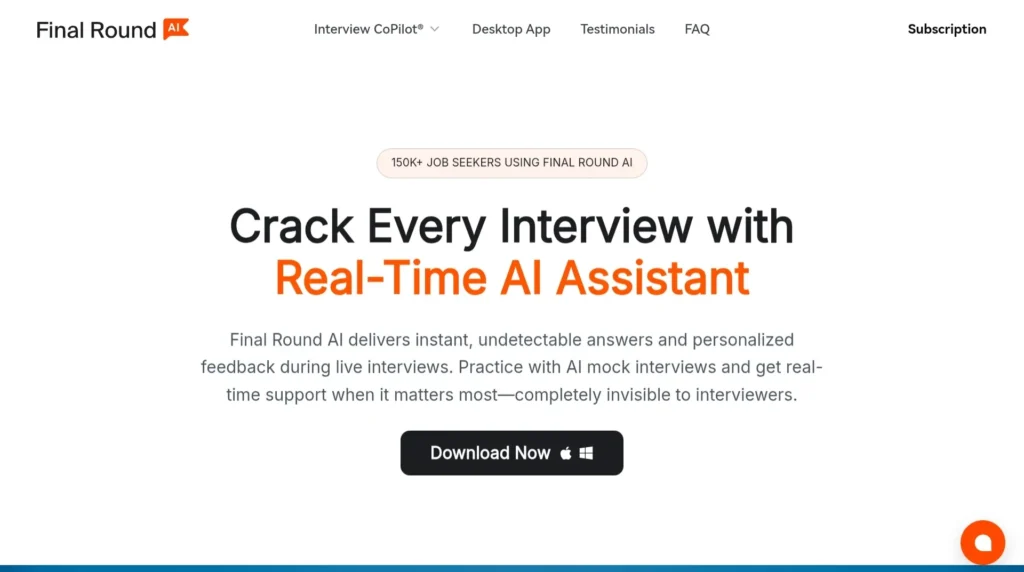
What impressed me first was how it starts with your resume. You upload it, and instead of giving generic questions, it actually builds interview scenarios based on your real experience. That alone made the practice feel far more relevant than random question banks.
Then it goes a step further. You can match your profile with a specific job role or description, and it generates tailored interview questions based on that context. This is where things start to feel very close to what Mercor does (adaptive questioning based on your background.)
The mock interview feature is where it really stands out. It simulates a voice or video-style interview, which helped me get used to speaking out loud instead of typing or thinking silently.
What I found especially useful was the instant feedback system. After each answer, it doesn’t just tell you good or bad. It breaks down what was unclear, where you rambled, and how you could structure your response better. It even suggests improved sample answers, which helped me understand how to tighten my own responses.
There’s also a more advanced layer that I didn’t expect, something like an interview copilot feature that supports you during live interviews. I didn’t rely on it heavily, but knowing it exists helped me understand how structured modern interview systems are becoming.
Overall, it felt less like a practice app and more like a full training environment.
Teal AI Interview Practice: The Underrated Alternative That Focuses on Clarity
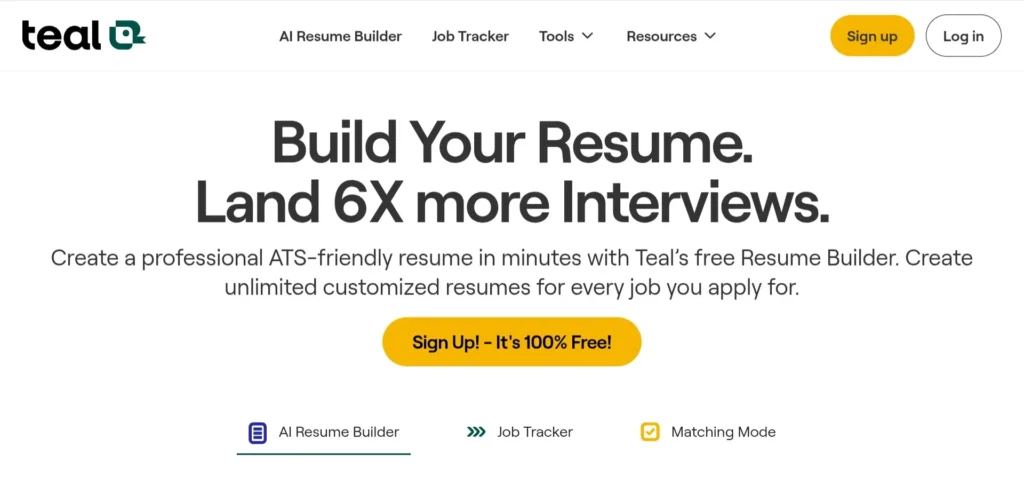
Teal AI Interview Practice felt simpler compared to Final Round AI, but in a good way. It’s more focused, less overwhelming, and very practical if you just want consistent practice without too many extra features.
What I liked most is how it builds questions directly from job descriptions. You paste a role you’re applying for, and it generates realistic interview questions that actually reflect what companies might ask. That made my practice sessions feel grounded in real opportunities rather than abstract preparation.
It also supports video recording, which turned out to be more important than I expected. You can watch yourself answer questions revealing habits you didn’t notice while speaking like talking too fast, avoiding eye contact with the camera, or overusing filler phrases.
Another strong point is its transcript-based feedback and analytics. Instead of just reviewing your performance subjectively, it shows patterns over time like whether your answers are getting more structured or if you’re still rambling under pressure.
Final Thoughts
Looking back, the most important lesson from the Mercor AI interview wasn’t about memorizing frameworks or perfecting answers.
It was about communication clarity. Not fancy communication. Not impressive storytelling. Just clear, structured thinking expressed through simple language.
The system doesn’t need you to be overly polished. It needs your experience to be understandable. That’s it.
Once I stopped overcomplicating things, everything became easier. I didn’t need to change who I was. I just needed to express my experience in a way that could be cleanly interpreted by both a system and a person.
If there’s one takeaway I’d share, it’s this: the interview isn’t testing how impressive you sound. It’s testing how clearly your experience can be understood.
